The Korean War
The war began in 1950 and ended with an armistice in 1953 rather than a peace treaty. Service, separation, casualty reports, and uncertainty affected families far from the fighting.

Chapter 4
News and World Events
Explore the Korean War, civil rights, the Cold War, presidential leadership, television news, and the first years of the Space Age.
Inside the chapter
All 11 named subjects from this chapter are included below.
The war began in 1950 and ended with an armistice in 1953 rather than a peace treaty. Service, separation, casualty reports, and uncertainty affected families far from the fighting.
Tension between the United States and Soviet Union influenced schools, workplaces, films, politics, and news. Civil-defence drills and public information campaigns made international rivalry feel personal.
Thermonuclear weapons increased the scale of possible destruction. News reports, tests, shelters, and public debate combined scientific achievement with deep anxiety.
Dwight D. Eisenhower entered the White House with the stature of a wartime commander. His presidency included the Korean armistice, Cold War crises, civil-rights confrontations, and major domestic construction.
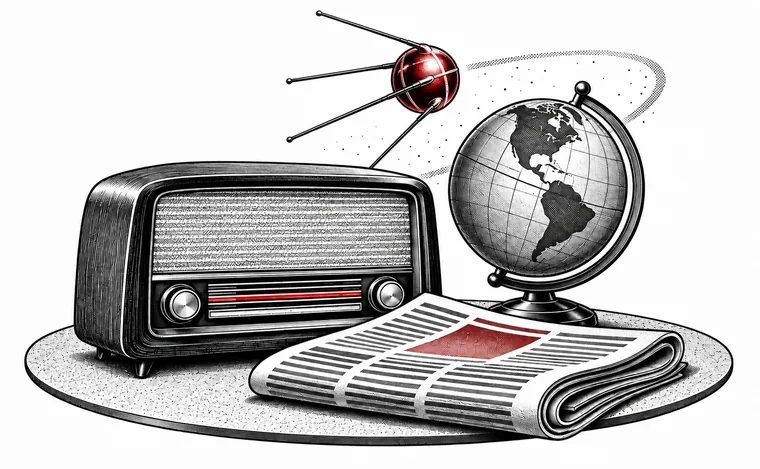
The Soviet launch of Sputnik in 1957 shocked many Americans and intensified interest in science and education. Its radio signal made the beginning of the Space Age something people could actually hear.
Television brought conventions, hearings, speeches, disasters, and world events into the home. Viewers increasingly associated news with both pictures and familiar broadcasters.
Rosa Parks’s arrest in 1955 helped spark a sustained boycott led by local activists and the Montgomery Improvement Association. The campaign demonstrated the power of organised nonviolent protest.
Nine Black students entered Central High School in 1957 under federal protection. The crisis exposed resistance to school desegregation and the federal government’s responsibility to enforce court orders.
In 1954, the Supreme Court ruled that racial segregation in public schools violated the Constitution. Implementing the decision met strong resistance and required years of further legal and political action.
Radio bulletins and television pictures connected major events with ordinary rooms and family routines. People often remember where they were, who was present, and how the adults around them reacted.
The decade held nuclear anxiety, war, and injustice alongside scientific advances, economic growth, and campaigns for equality. Remembering both sides gives the period a fuller human shape.
Optional companion material
A free one-time Resource Pass unlocks every companion video and trusted historical link on this browser. Press Play to load privacy-enhanced video.