
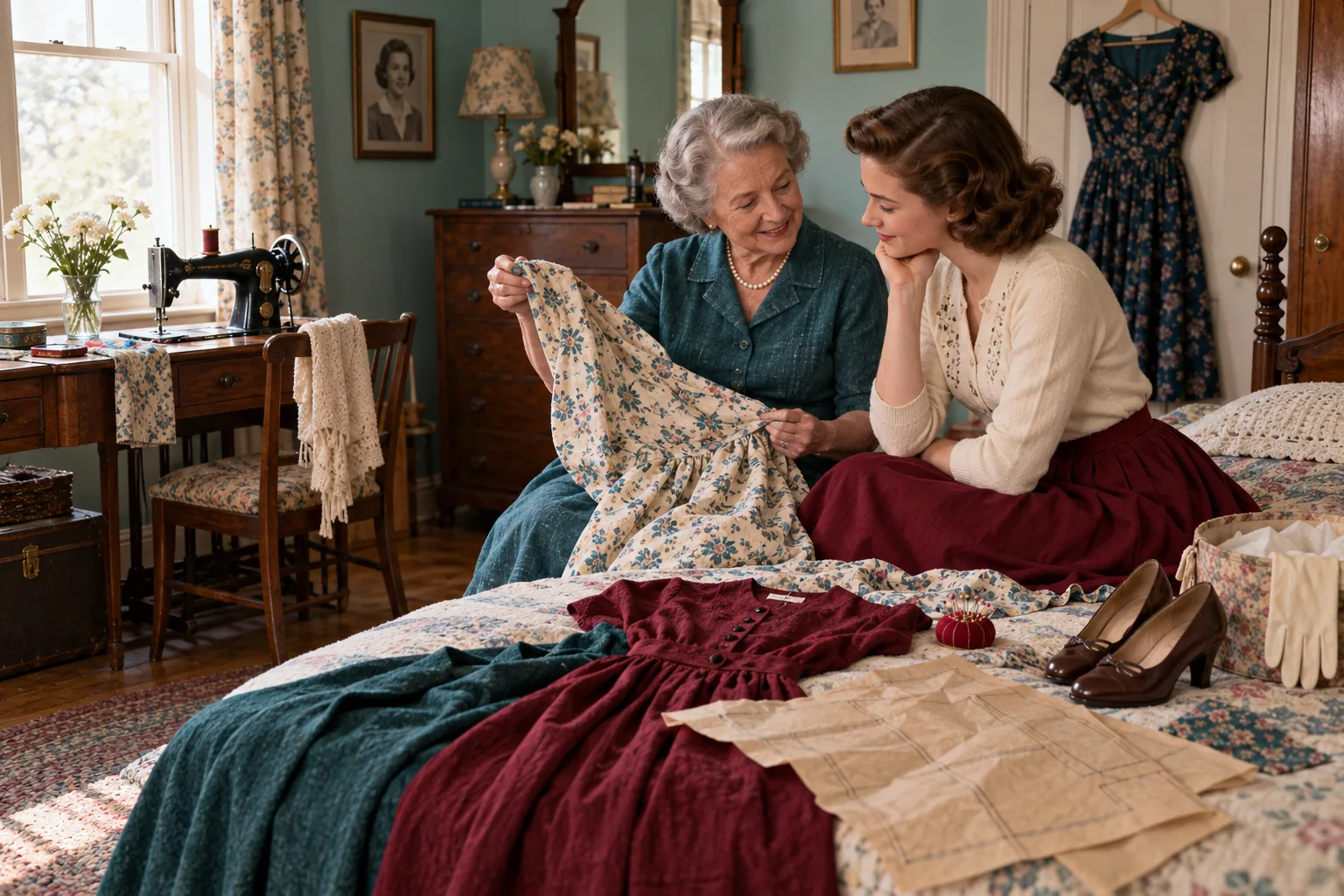
Popular nostalgia often reduces 1950s fashion to a few symbols. Real wardrobes depended on age, work, income, region, culture, and occasion.
Begin with ordinary clothes
Ask what people wore to school, work, church, the shops, or around the house. Everyday garments may produce stronger memories than formal fashion.
Remember making and mending
Patterns, fabric counters, altered hems, hand-me-downs, and repaired clothing were part of many households. Ask who taught sewing or cared for clothes.
Use photographs carefully
A photograph can prompt talk about the occasion, companions, and location, not only appearance. Avoid comments that judge bodies or imply that everyone dressed the same way.
Compare choice and expectation
Which clothes felt comfortable? Which were required? Which item represented independence? These questions reveal social history as well as style.
Use everyday clothing as the starting point
Ask what someone wore to school, work, shops, worship, sport, or at home. Uniforms, overalls, aprons, sensible shoes, coats, and hand-me-downs may connect more strongly than an iconic party outfit.
Invite people to describe what felt comfortable, what was required, and what they would have chosen differently. Clothing can reveal rules and identity as well as style.
Remember buying, making, and adapting
Clothes might be bought from a department store, local shop, catalogue, market, or second-hand source. Other garments were made at home, altered, repaired, or passed between relatives.
Use a pattern, button tin, fabric sample, tape measure, or photograph as a prompt. Choose safe, clean objects and avoid fragile family items in a group setting.
Ask about skill and labour
Who measured hems, darned socks, polished shoes, washed delicate fabric, or pressed a uniform? Was the work taught at home or school? Did someone enjoy it, dislike it, or earn money from it?
These questions recognise the practical labour behind appearance. They also make room for tailoring, factory work, laundry, retail, and other clothing-related jobs.
Include hair, accessories, and preparation
A remembered outfit may include a hat, handbag, tie, jewellery, gloves, headscarf, hairstyle, cosmetics, or scent. Ask how long it took to get ready and who offered advice.
Strong scents should not be used casually in a session because of allergy and sensory concerns. A photograph or empty clean container can provide a safer prompt.
Use photographs without judging bodies
Focus first on the occasion, companions, place, and personal choice. Avoid remarks about weight, youth, attractiveness, or whether someone “looked better then.” Such comments can make a warm activity feel exposing.
Ask permission before sharing a personal photograph with a group. Use copies and return originals to safe storage.
Questions that move beyond costume
- Which clothes were kept for best?
- Was there an item you saved to buy?
- What did work or school rules require?
- Who was good at making or repairing clothes?
- Which fabric or garment was uncomfortable?
- When did you first choose your own style?
Questions about choice and expectation help connect fashion with independence, work, income, culture, and social change.
Build a tactile activity carefully
Offer a few contrasting fabrics on large cards and invite participants to choose a favourite texture, colour, or possible use. Do not require anyone to close their eyes or touch a material.
A group can assemble an outfit for an imagined occasion using pictures. The task encourages discussion without requiring personal disclosure or fine sewing skills.
Compare without idealising the decade
Talk about comfort, cost, repair, choice, uniforms, and expectations today. Ask which changes people welcome and which older habits, such as mending or careful buying, they value.
The richest fashion memories are not a parade of stereotypes. They show how real people dressed for the work, rules, celebrations, climate, and opportunities of their own lives.
Create a clothing timeline without exact dates
Choose four life stages, such as school, first work, celebrations, and later everyday life. Invite participants to place copied clothing pictures beside a stage and explain their choices. Exact years are not required. Add notes about comfort, rules, cost, repair, and personal style. The timeline helps a group see change across one life rather than treating the 1950s as a single fixed look. It can also reveal which subject deserves a separate session. Include clothes people chose to stop wearing, because changing a style can say as much about independence as adopting one.