
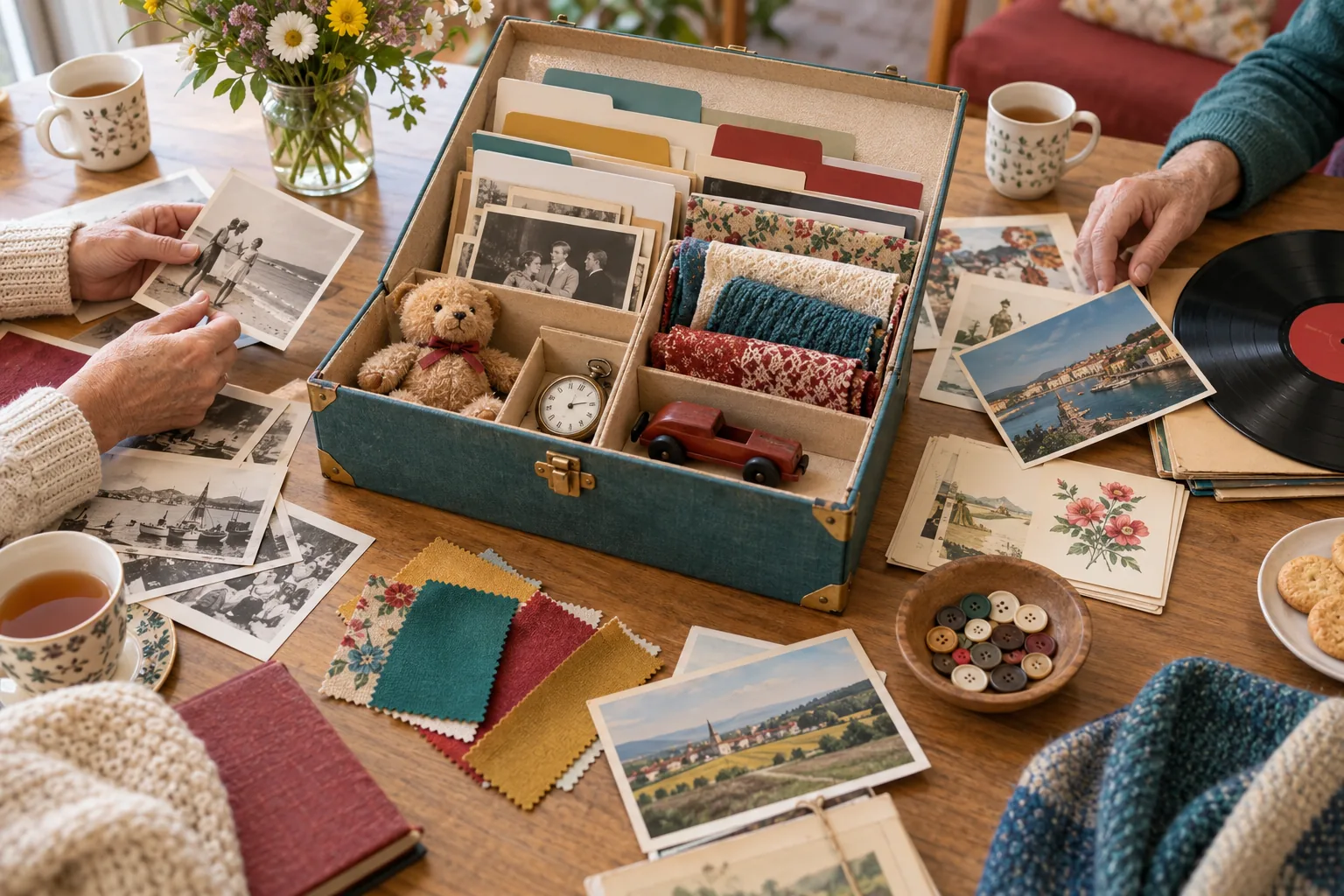
A reminiscence kit is a small collection of prompts that can make conversation easier. It does not need rare antiques or expensive equipment. Familiar, safe, well-chosen items are usually more useful than a crowded box.
The kit can support a family visit, a community group, or an activity session. It should invite interest without requiring anyone to identify an object or supply the “right” answer.
Choose one clear theme
Begin with a subject broad enough to include different experiences. Good options include school days, music, kitchens, work, travel, celebrations, gardens, clothes, or games.
One theme keeps the box manageable. You can create additional folders later and swap them into the same container.
Add four kinds of prompt
- Pictures: copied family photographs, postcards, magazine-style images, or illustrations from a reminiscence book.
- Sounds: a short playlist, radio theme, street sound, or familiar piece of music.
- Textures: a fabric swatch, wool, ribbon, smooth wood, or another clean material linked to the theme.
- Everyday objects: a safe utensil, ticket, recipe card, toy, tool, button tin, or empty package.
Three to five items from each group are enough. A smaller choice is easier to see, handle, and discuss.
Use copies when originals matter
Do not place irreplaceable photographs, fragile letters, or valuable keepsakes in a shared kit. Use high-quality copies and store originals safely.
Remove sharp edges, small loose parts, strong smells, breakable glass, and anything that could be mistaken for food or medicine. Follow the setting’s infection-control, allergy, and safeguarding procedures.
Make every item easy to handle
Mount photographs on firm card with a plain border. Choose objects that can be picked up without fine finger control. Keep audio controls simple and set the volume before the session.
Large labels can help the facilitator organise the box, but avoid putting an answer on the front of every prompt. A picture can remain open to interpretation.
Prepare a few gentle questions
Write five prompts on a separate card. Try: “What do you notice first?”, “Does this remind you of a place?”, “Who might have used something like this?”, “How does it feel?”, and “Would you like to choose another?”
These questions allow opinion and imagination. They do not depend on exact recall.
Use the kit slowly
Introduce one item, wait, and observe. Someone may speak, smile, point, hum, or simply hold the object. All are valid ways to take part.
If an item brings discomfort, put it aside without asking for an explanation. Move to a neutral subject or pause the activity. Reminiscence is not always cheerful, and participation should remain voluntary.
Keep a simple session note
Afterward, record which items connected well, which were ignored, and any preferences the person chose to share. Do not record sensitive personal details unless your organisation has a clear reason and permission to do so.
Refresh the kit over time. A Memory Lane decade guide can help you choose themes and companion media, while the physical objects make the session personal and flexible.
Organise the kit so another person can use it
Place each theme in a large envelope or shallow tray. Add a one-page guide with the theme, five open questions, a materials list, safety notes, and the approximate session length. Clear organisation prevents the activity from depending on one facilitator’s memory.
Use large labels and a contents photograph. Check the kit after every session so that missing, damaged, or unsuitable items are not passed to the next group.
Create a useful starter kit
A first box might contain two themes rather than ten. For “Journeys,” include a map, postcards, a ticket copy, a fabric luggage label, and a short transport sound. For “Home,” include room photographs, a wooden spoon, fabric, a household catalogue image, and a radio clip.
Choose objects for conversation value, not age or monetary value. A modern copy can work when it clearly represents a familiar shape or task.
Review safety and relevance regularly
Clean or replace items according to the setting’s procedures. Remove outdated technology that no longer works reliably, personal information left inside objects, and photographs used without permission.
Ask participants what the box is missing. Their suggestions will make the kit more representative and may lead to new themes that an activity catalogue would never predict.