
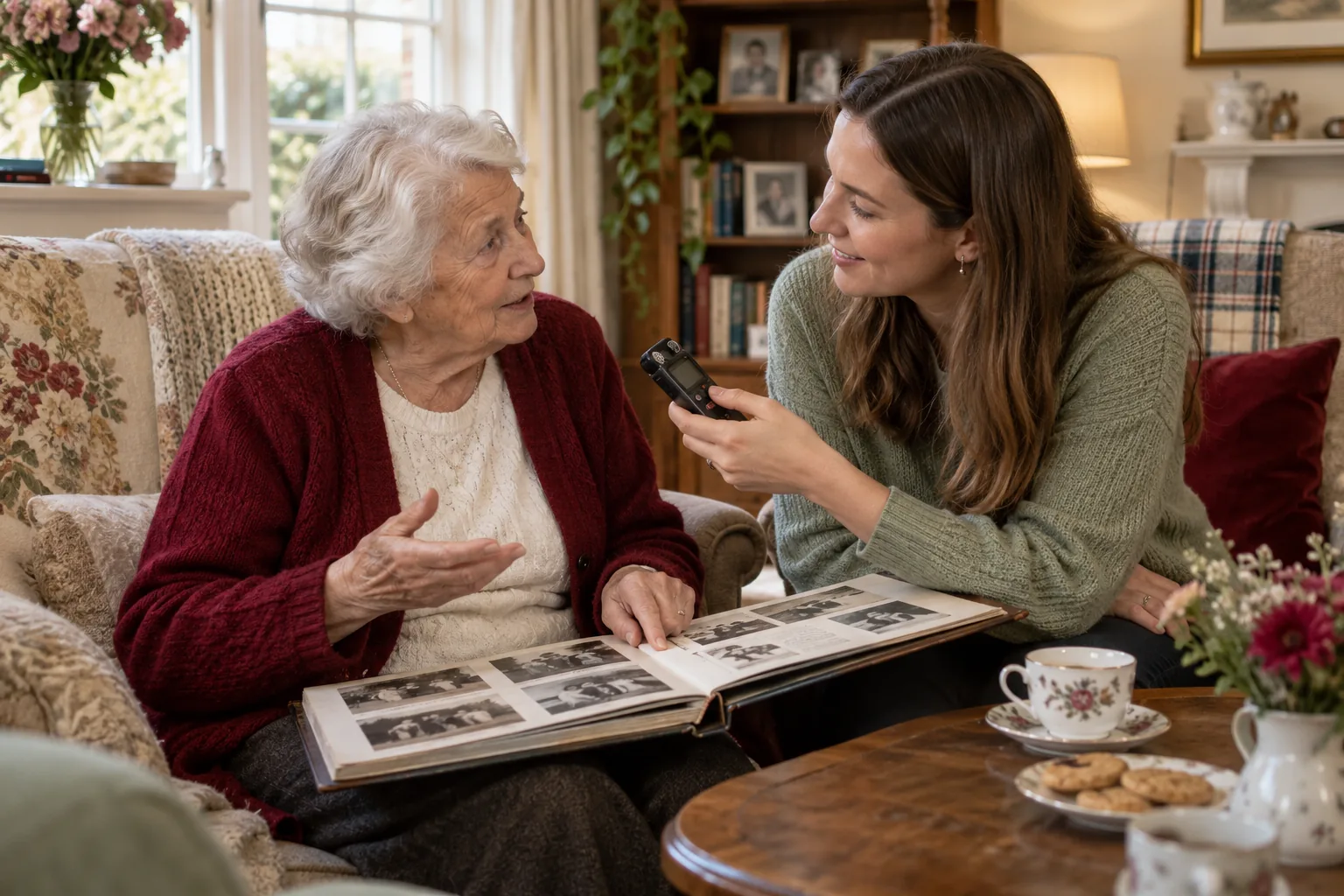
Family stories often live in ordinary conversation: how two people met, why a recipe changed, what a first job felt like, or who always made everyone laugh. Recording a few of these stories can become a treasured family resource.
The process should feel like time together, not an interrogation. Begin small, ask permission, and let the storyteller decide what matters.
Choose one subject for each visit
“Tell me your life story” is a large request. A narrower invitation is easier: a school day, a family journey, a favourite room, a celebration, a job, or a song.
Use a photograph, object, or page from a nostalgia book as a starting point. The prompt may lead somewhere unexpected. Follow the story rather than forcing a prepared list.
Ask before you record
Explain what you would like to do, who may hear or read the result, and where it will be stored. Ask again on another day; agreement once does not cover every future recording.
Respect a “no,” a change of mind, or a request to stop. Some stories are private, painful, or simply not yours to preserve.
Keep the equipment simple
A phone or small audio recorder is usually enough. Put it close enough to capture speech without becoming the centre of attention. Test the sound for one minute before beginning.
Choose a quiet room, silence notifications, and avoid recording over background television or loud music. Ten clear minutes are more useful than an hour that is difficult to hear.
Use open, concrete prompts
Try “What happened next?”, “What did the place look like?”, “Who was there?”, or “How did you feel about it then?” Ask one question at a time and allow pauses.
Do not correct a date while the person is speaking. If accuracy matters, check names and dates later and keep that note separate from the person’s own account.
Notice the small details
Everyday details give a story life: the bus route, a coat colour, a shop window, a nickname, or the smell of a kitchen. Invite description, but do not push when a detail will not come.
Silence, laughter, and changes of subject are part of the conversation too. Editing can make audio easier to follow, but avoid changing the meaning or tone.
Name and store each file
Use a simple file name with the person, subject, and date. Keep a second copy on another trusted device or secure storage service. Write a short note explaining who recorded it and what permissions were given.
If you make a transcript, retain the audio. A voice carries pace, humour, and emotion that written words cannot fully preserve.
Share something back
Make a short printed story, a private family audio collection, or a small book with copied photographs. Let the storyteller review it where possible and choose who receives it.
For your next conversation, browse the themes in the Memory Lane 1950s edition. Use one page as an invitation, then put the book aside when the family story begins.
Prepare a simple recording agreement
Write down who is recording, what the conversation is about, where the file will be kept, and who may receive a copy. Use plain language and treat the agreement as a continuing conversation rather than a one-time signature.
Ask whether any subject, name, or story should remain private. Mark restrictions clearly beside the file so they do not get lost when recordings are copied.
Make questions easier to answer
Arrange prompts in a gentle order: place, routine, people, event, and reflection. Begin with description before asking how something felt. Keep a list nearby, but do not read it mechanically.
Use follow-ups such as “What could you see from there?” or “What happened on an ordinary day?” Specific prompts often bring useful detail without demanding exact dates.
Preserve context with the story
After recording, note the full name the storyteller wants used, approximate date, location, people mentioned, and the object or photograph that prompted the account. Keep uncertainty visible instead of guessing.
File names should be clear but not expose sensitive details. Maintain at least two secure copies and review access when devices or storage accounts change.
Create versions people can use
A full recording can be accompanied by a short excerpt, large-print transcript, photograph page, or private family index. Label edited extracts so listeners understand that material was shortened.
Return a copy to the storyteller in a format they can access. Recording family history should not remove the story from the person who shared it.