
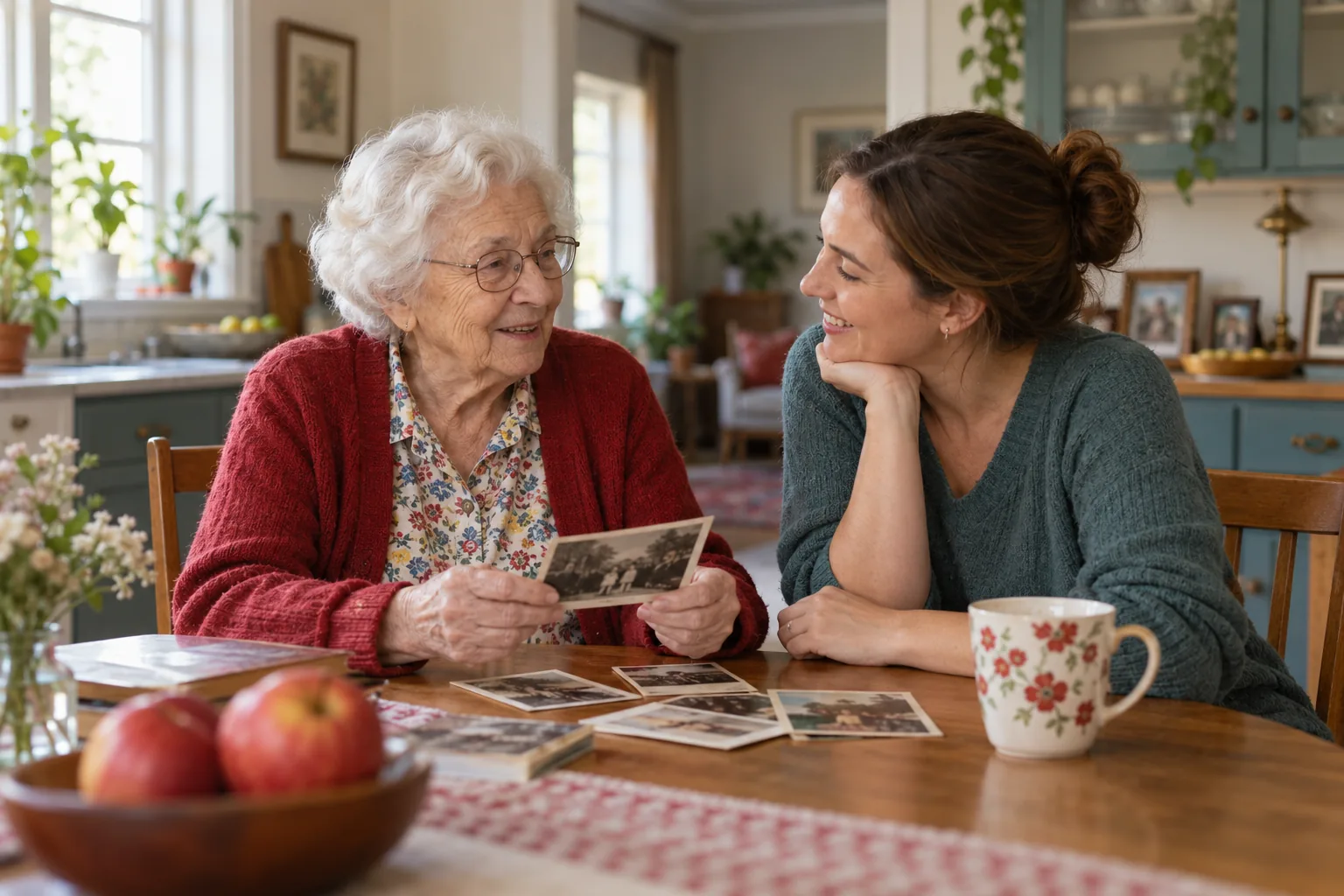
A nostalgia question works best when it feels like an invitation. The goal is not to prove what someone remembers; it is to make it easier to share a thought, feeling, preference, or story.
Ask open, low-pressure questions
Instead of “Who sang this song?”, try “Does this song sound familiar?” or “Where might you have heard music like this?” A person can join in without needing a precise name or date.
Allow time
Read slowly, then wait. Older adults may need extra time to hear the question, search for a memory, and decide how they want to answer. Filling every pause can accidentally close the space you meant to create.
Accept every level of participation
Listening, smiling, humming, choosing between two pictures, or saying “I don’t remember” are all valid responses. Move on warmly when a prompt does not connect.
Follow the story
If a question about radio leads to a story about a neighbour, stay with the neighbour. The unexpected path is often where the meaningful conversation lives.
Why low-pressure questions work better
A factual question usually has one expected answer. A conversation prompt has many possible answers. That difference matters. “What did you enjoy listening to?” allows a person to name a song, describe a room, talk about a relative, or simply say that music was not important in their home.
Questions about opinion, senses, routines, and personal choice also make room for different backgrounds. Not everyone owned a television, travelled by car, attended the same kind of school, or remembers an era fondly. An open prompt lets the person describe their own version of the past.
Prepare a small choice of prompts
Choose one theme and prepare three to five prompts. Bring one clear photograph, a safe object, a short piece of music, or a page from a reminiscence book. Too many materials can make it harder to know where to begin.
Think about the person before the activity. Interests, work, family traditions, culture, and places lived are more useful than assumptions based only on age. Check that sound is comfortable, print is easy to see, and the setting is free from avoidable interruptions.
Use prompt patterns that leave room
- Observation: “What do you notice in this picture?”
- Preference: “Which of these would you have chosen?”
- Sensory: “What sounds might you have heard here?”
- Routine: “What usually happened at this time of day?”
- Change: “What feels most different from today?”
- Invitation: “Does this bring any person or place to mind?”
These patterns can be used with almost any topic. They also allow someone to answer from imagination or general knowledge when a personal memory does not come.
Avoid turning a follow-up into correction
When a detail sounds uncertain, decide whether accuracy is actually needed. During an enjoyable reminiscence activity, correcting the year, singer, street, or sequence may interrupt a meaningful story. You can respond to the feeling or subject: “That journey sounds memorable” or “You clearly liked that song.”
If a practical decision depends on accurate information, check it later through an appropriate source. Keep that task separate from the conversation itself.
Adapt for different ways of communicating
Offer two pictures to choose between, invite a gesture, or describe what you see. Someone may prefer to listen while another person speaks. A person with limited speech may show interest through expression, movement, eye direction, or touch.
Do not make every silence a problem. A pause can mean thinking, resting, listening, or deciding not to answer. Continue only when the person appears comfortable.
Use the same approach in a group
Address the whole group, then allow anyone to respond. Avoid moving around the circle demanding an answer from each person. Invite contrasting experiences: “Did anyone do this differently?” This makes the discussion richer without deciding that one memory is the standard.
If one person speaks often, thank them and open the space gently: “Let’s see whether anyone else would like to add something.” Small-group pairs can help quieter participants join without performing in front of everyone.
End with choice and appreciation
Close before people become tired. Ask whether they would like another picture, a favourite song, or to finish. Thank participants for their company rather than praising how much they remembered.
The measure of success is not the number of correct facts. It is whether the person had a comfortable opportunity to notice, choose, connect, and share in their own way.