
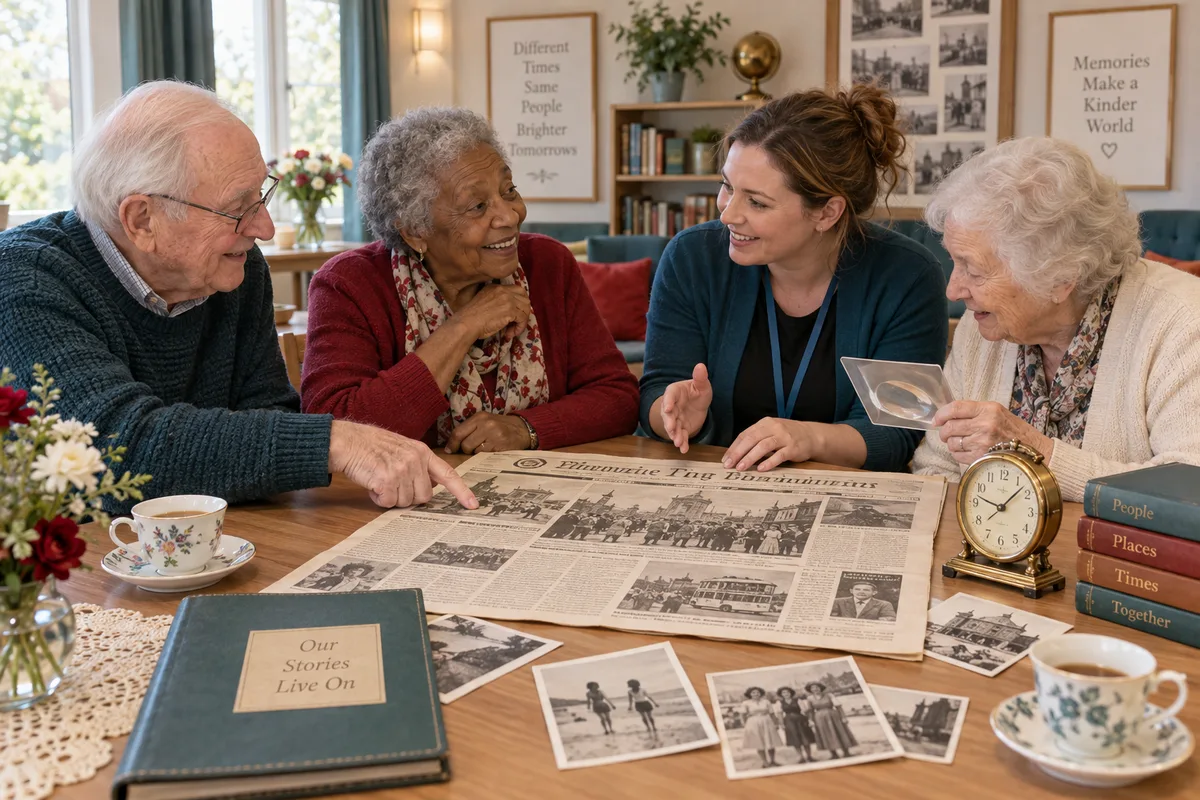
A local newspaper offers more than headlines. Its pages hold shop advertisements, cinema listings, school results, weather, weddings, sports, recipes, job notices, and letters from readers. These small details can help a group picture how a community looked and felt on an ordinary day.
The aim is not to test who remembers a news event. It is to use a primary source as a shared object. Participants can notice a price, typeface, place name, photograph, or phrase and take the conversation in a direction that matters to them.
Choose an ordinary week
Famous front pages can be powerful, but they may dominate the session or bring difficult memories. Begin with an ordinary week connected with the group’s area or age range. Search for a local paper from a season rather than an exact birthday. A page from spring 1956, for example, may offer more ways into conversation than a single major event.
The Library of Congress describes historic newspapers as primary sources that help readers see how people encountered events in real time. Its Chronicling America maps and visualizations can help locate digitised American titles. Local libraries, state archives, and historical societies may provide additional collections.
Prepare readable extracts
Do not expect participants to navigate a full, densely printed page. Select four to six extracts and print each on separate paper. Enlarge the type and image together, keep strong contrast, and add a plain caption with the paper’s name and date. Preserve the original wording, including outdated terms, but be ready to explain context.
A balanced set might include a grocery advertisement, a short community notice, one local photograph, a sports result, a weather report, and a cinema listing. Check that names and dates are legible. Avoid distressing crime reports, graphic photographs, and private family announcements unless the group has specifically chosen that subject.
Start with what people can see
Place one enlarged extract in the centre and read the heading aloud. Try questions such as “What catches your eye?”, “Would this have been good value?”, “Where was that shop?” or “What else might have been happening in town that day?” A person can comment without having lived in the area or remembering the year.
Comparisons work well. Show a modern advertisement beside the older one and ask what changed in packaging, language, choice, or price. Avoid asking people to calculate historic values on the spot. The social meaning of shopping, saving, or treating the family is often more engaging than arithmetic.
Make room for different histories
Newspapers reflect the priorities and prejudices of their publishers and period. They may omit communities, use language that is now offensive, or report claims that were later corrected. Say clearly that a newspaper shows what was printed at the time, not a complete or neutral account.
Invite participants to add what the page leaves out: neighbourhood news passed by word of mouth, community organisations, immigrant businesses, Black press coverage, women’s unpaid work, or events remembered differently. A missing perspective can become an important part of the discussion.
Try a 30-minute session
- Welcome the group and explain the source and date.
- Explore two everyday extracts slowly.
- Pause for a drink or stretch.
- Compare one older item with a modern equivalent.
- Let the group choose the final extract.
- Close by asking what should be researched next.
If someone shares a personal story, ask permission before writing it down or displaying it later. Note the source details separately so future readers can distinguish the participant’s account from the newspaper record.
Keep a clear source trail
Write the newspaper title, place, date, page number, archive, and stable web address on every printed extract. This helps another facilitator find the page again and prevents a caption from becoming detached from its source. If optical character recognition produced the text, compare names, prices, and dates with the scanned page because automated transcripts can contain errors.
Keep your own summary separate from the historic text. Participants should be able to see which words were printed at the time and which explanation was added for the activity.
Finish with curiosity, not a quiz
The Library of Congress offers a helpful introduction to exploring Chronicling America, including topic guides and search approaches. Use archives to open questions, then let lived experience give the activity its depth.
A successful newspaper session may end with a remembered shopkeeper, a debate about school dinners, a laugh over an advertisement, or a new question for the local library. Those connections matter more than correctly recalling the headline.