
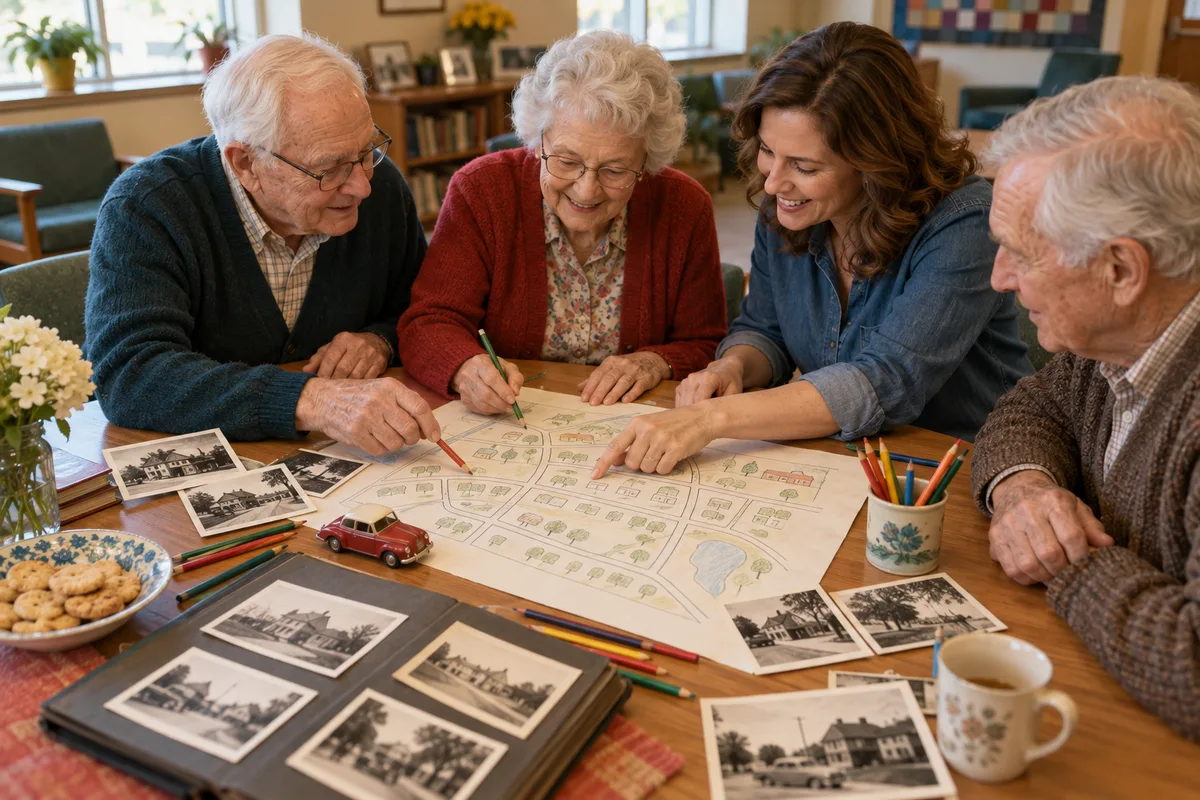
A map gives memories somewhere to land. A single street can lead to the corner shop, a bus route, a school gate, a place of worship, a factory, a park, or the home of a friend. People do not need to remember exact addresses. They can point, compare, draw, or simply listen as a place takes shape.
This activity works with one neighbourhood, several hometowns, or journeys between countries. The map is a conversation surface, not a geography test.
Choose the right kind of map
For a local group, print a large street map with clear labels and strong contrast. A historic map can be interesting, but pair it with a modern one so participants can orient themselves. For people from different places, use a country or world map alongside blank paper for individual sketches.
Do not use a current home address without consent. In a public display, keep house numbers, care locations, and other private details off the map. A general area is enough to support the story.
Begin with landmarks, not accuracy
Start with a river, main road, station, church, school, factory, or shopping street. Ask, “What would people have recognised here?” or “Where did daily errands take you?” If someone places a building on the wrong corner, resist moving it immediately. The location may be approximate, or the building may have moved.
Use removable notes or cards so nothing looks permanently wrong. Write phrases in the speaker’s own words when possible: “best bread after noon,” “bus to Saturday pictures,” or “steep hill in winter.” These details make the map personal.
Add routes and routines
Invite people to trace a familiar journey with a finger or a thick coloured line. Possibilities include home to school, a walk to work, a shopping round, a Sunday visit, or a trip to the cinema. Ask about what happened along the way: who travelled with them, what they carried, where they stopped, and how long it seemed to take.
For someone who does not want to map the past, offer a present-day route or an imagined ideal neighbourhood. Choice keeps the activity from becoming an obligation to remember.
Make space for change and loss
Places change. A favourite shop may have closed, a community may have been displaced, or a neighbourhood may carry experiences of segregation, migration, redevelopment, or conflict. Avoid saying that the past was simpler or better for everyone.
If a loss comes into the conversation, acknowledge it: “That place mattered,” or “It sounds as though a great deal changed.” Ask whether the person wants to add the lost place to the map. Remembering it can be meaningful, but nobody should be pressed to continue.
Try a flexible group plan
- Introduce the map and explain that approximate memories are welcome.
- Mark two or three shared landmarks.
- Invite one route at a time.
- Add photographs, shop names, sounds, or smells on removable cards.
- Pause after 20 minutes and ask whether to continue.
- Photograph the finished map only with permission.
For people with limited sight, describe the layout aloud and use raised string or thick tactile lines on a simple board. For limited dexterity, the facilitator can place cards exactly where the person directs. Keep the print large and the table free of unnecessary items.
Continue the story away from the table
If mobility and support arrangements allow, use the map to plan a short present-day outing or virtual street view session. Choose one comfortable destination, check access and toilets, avoid busy times, and be ready to turn back. The purpose is enjoyment, not completing a route.
A person who remains at home can choose a landmark for a relative to photograph. Compare the new picture with the map at the next session. This keeps the activity connected with the present instead of treating the neighbourhood only as something lost.
Use reliable sources as support
The Alzheimer’s Society specifically suggests local, national, or world maps as prompts for stories about places lived in or visited. The National Institute on Aging has also described research combining neighbourhood photographs, walking, social engagement, and reminiscence, while carefully noting that research questions remain. Its broader reminiscence guidance is a useful reminder to keep the person’s comfort and identity central.
When the session ends, the map does not need to be complete. Leave a little open space. It signals that more routes, people, and versions of the neighbourhood are still welcome.