
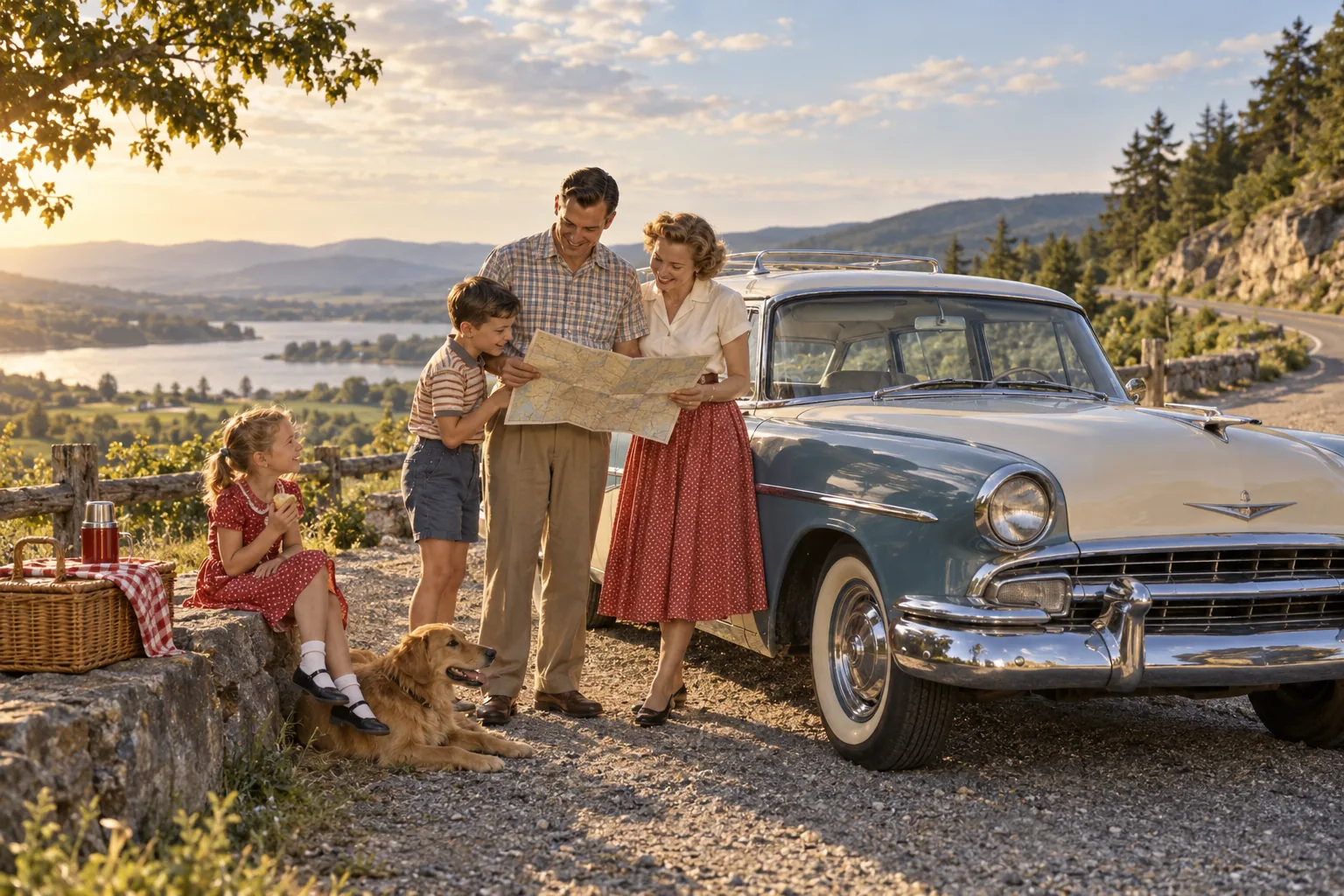
A remembered car is often a container for many other memories: learning to drive, sitting beside siblings, visiting relatives, or waiting at a filling station.
Describe the car
Ask about colour, upholstery, bench seats, radio, luggage, and the sound of the engine. Exact make and model are optional.
Follow the route
Paper maps, roadside signs, packed lunches, motels, and unplanned stops all offer prompts. A journey across town can be as meaningful as a long holiday.
Remember other transport
Not every household owned a car. Include buses, trains, bicycles, walking, and early commercial flights so the conversation remains open to different experiences.
Make a memory map
Draw a simple route and add places, people, food stops, songs, or landmarks. The map does not need to be geographically exact to hold a good story.
Begin with how the journey started
A trip may have begun with careful saving, a borrowed car, a railway timetable, or sandwiches packed before dawn. Ask who planned, who packed, and how people knew the route. Preparation often reveals family roles and practical creativity.
Not every household travelled for holidays. A visit across town, a Sunday drive, a bus to the market, or a train to see relatives can carry just as much meaning.
Use the vehicle as a doorway
If a car is remembered, ask about colour, seats, doors, luggage, heating, radio, repairs, and the sound of the engine. Exact make and model can be added when someone enjoys that detail, but they should not become a quiz.
Include motorcycles, bicycles, buses, coaches, trains, ferries, and walking. Showing several forms of transport prevents car ownership from becoming the assumed experience.
Remember what happened between stops
Paper maps, arguments about direction, travel sickness, songs, games, packed food, weather, and roadside repairs can be more vivid than the destination. Ask where people sat and what they did while waiting.
A short sound, such as a train, indicator, station announcement, or engine, can prompt a response. Keep the volume comfortable and avoid using several sounds at once.
Talk about roadside life
Filling stations, cafés, picnic places, motels, guest houses, service areas, and scenic viewpoints all changed over time. Use photographs to compare without claiming that one image represents every region.
Ask what made a stop welcome. Was it a cup of tea, clean facilities, a playground, a view, or simply a chance to stretch? Practical details make travel history human.
Build a memory map
- Draw a simple line between the starting point and destination.
- Add people who travelled, without worrying about exact geography.
- Mark a food stop, song, landmark, delay, or surprise.
- Use symbols or copied pictures when writing is difficult.
- Invite another person to add a different route or journey.
The finished map does not need to be accurate enough for navigation. Its purpose is to hold a sequence of personal details and make them easier to share.
Adapt the activity for a group
Display two large images and ask the group which route to explore first. One person may talk about a car while another remembers a railway platform. Link the stories through common themes such as waiting, packing, weather, or arriving.
Avoid ranking who travelled farthest. Local journeys, migration, military travel, and trips made for work or care can all carry strong emotions. Let participants decide how much to share.
Bring the journey back to the present
Compare maps, booking, luggage, roads, comfort, and communication today. Ask which modern change people value and which older habit they would keep. This invites opinion even when a specific journey is hard to recall.
Finish by choosing one picture or route for a future session. Travel reminiscence works best when the vehicle leads to people and places, not when the conversation stops at horsepower and model names.
Prepare prompts for people who did not take holidays
Travel questions can unintentionally suggest that every family owned a car or went away each year. Include journeys made for work, shopping, school, worship, visiting, migration, or medical care. Ask about staying at home during holiday periods and welcoming travelling relatives. A bicycle ride, daily bus, walk to work, or first train journey can hold as much social history as a long road trip. This broader approach helps more people find an honest place in the conversation.