
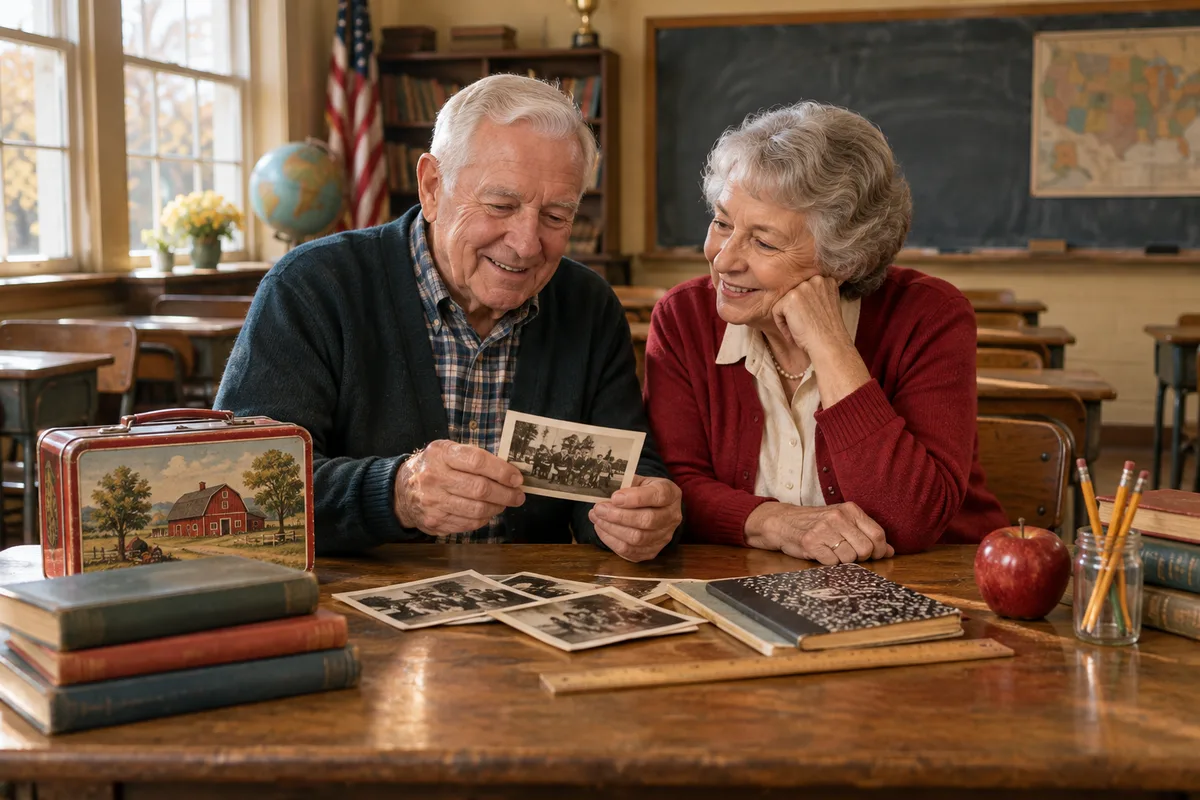
Schooldays are often treated as a cheerful universal subject, but people’s experiences differ greatly. Someone may remember close friends and a favourite teacher. Another person may recall punishment, discrimination, interrupted education, evacuation, frequent moves, or leaving early to earn money. Some participants attended school in another country or learned most useful skills at home and work.
An inclusive session does not assume that everyone loved school or followed the same path. It offers several ways to join in and makes passing as easy as speaking.
Prepare prompts beyond the classroom
Collect a small set of safe, familiar materials: a slate or notebook, pencils, a school photograph, a lunch tin, a map, playground game pieces, and a copy of a report card with private details removed. Modern replicas are fine. Use large, clear pictures rather than tiny originals.
Add prompts about the journey to school, clothes, meals, friendships, chores, first jobs, and learning at home. This helps people whose formal education was brief or disrupted take part without having to explain why.
Set a welcoming frame
Begin by saying, “We are going to explore learning and growing up. There are no right answers, and you can talk, listen, or pass.” That one sentence reduces pressure and widens the subject.
Show one item at a time. Ask, “What do you notice?”, “How might this have been used?” or “Does this remind you of learning something?” Avoid a quiz about dates, spelling, arithmetic, or famous teachers. Even a playful test can revive anxiety for someone who struggled at school.
Use themes that allow different stories
- Getting there: walking routes, buses, bicycles, weather, siblings, and crossing patrols.
- The school day: assemblies, desks, lessons, break time, lunch, and going home.
- Learning elsewhere: recipes, repairs, farming, languages, music, faith, trades, and family responsibilities.
- Friendship and belonging: games, clubs, uniforms, nicknames, and people who helped.
- Looking forward: hoped-for jobs, first wages, further study, and skills learned later in life.
Invite comparisons without demanding consensus. Rural and city schools, public and private schools, segregated and integrated education, and schooling in different countries could be very different. “What was it like where you were?” is more respectful than “We all had the same.”
Add an activity without making it childish
Offer an adult choice, such as marking a remembered route on a map, arranging photographs into themes, identifying useful life skills, or choosing a song linked with school years. Avoid worksheets that imitate a child’s classroom unless participants request them.
A group could create a display titled “What We Learned In and Out of School.” Contributions might include mental arithmetic, mending, caring for siblings, public speaking, gardening, typing, driving, or learning a new language. This values the whole life, not only certificates.
Respond carefully to difficult memories
If someone mentions bullying, punishment, racism, poverty, or missed opportunities, listen without trying to turn the story positive. Say, “That sounds as though it was hard,” or “Thank you for telling us.” Ask whether they want to continue, change the subject, or take a break.
The Alzheimer’s Society activities handbook recommends adaptable, meaningful activity and sensitivity to difficult memories. That guidance is especially important with subjects that may carry shame or exclusion.
Share the group’s work carefully
A display can celebrate the session, but ask before using names, photographs, or personal stories. Some people may want their contribution read aloud but not pinned to a public board. Others may prefer a first name, an anonymous quote, or no record.
Keep any display at an adult reading height with large, plain type and strong contrast. Include different kinds of learning, not only academic success. Remove it when the agreed period ends, and return personal materials promptly.
A photograph of the finished display can be offered privately to participants who want a copy, without assuming that everyone does.
Close with present-day strengths
Finish by asking, “What is something you learned that has stayed useful?” or “What would you enjoy showing someone younger?” National Institute on Aging guidance highlights meaningful, enjoyable activities and the value of participation that supports purpose and connection.
A good schooldays session does not produce one rosy picture of the past. It reveals different routes through learning and gives each person control over what they share. That variety is the real lesson.