
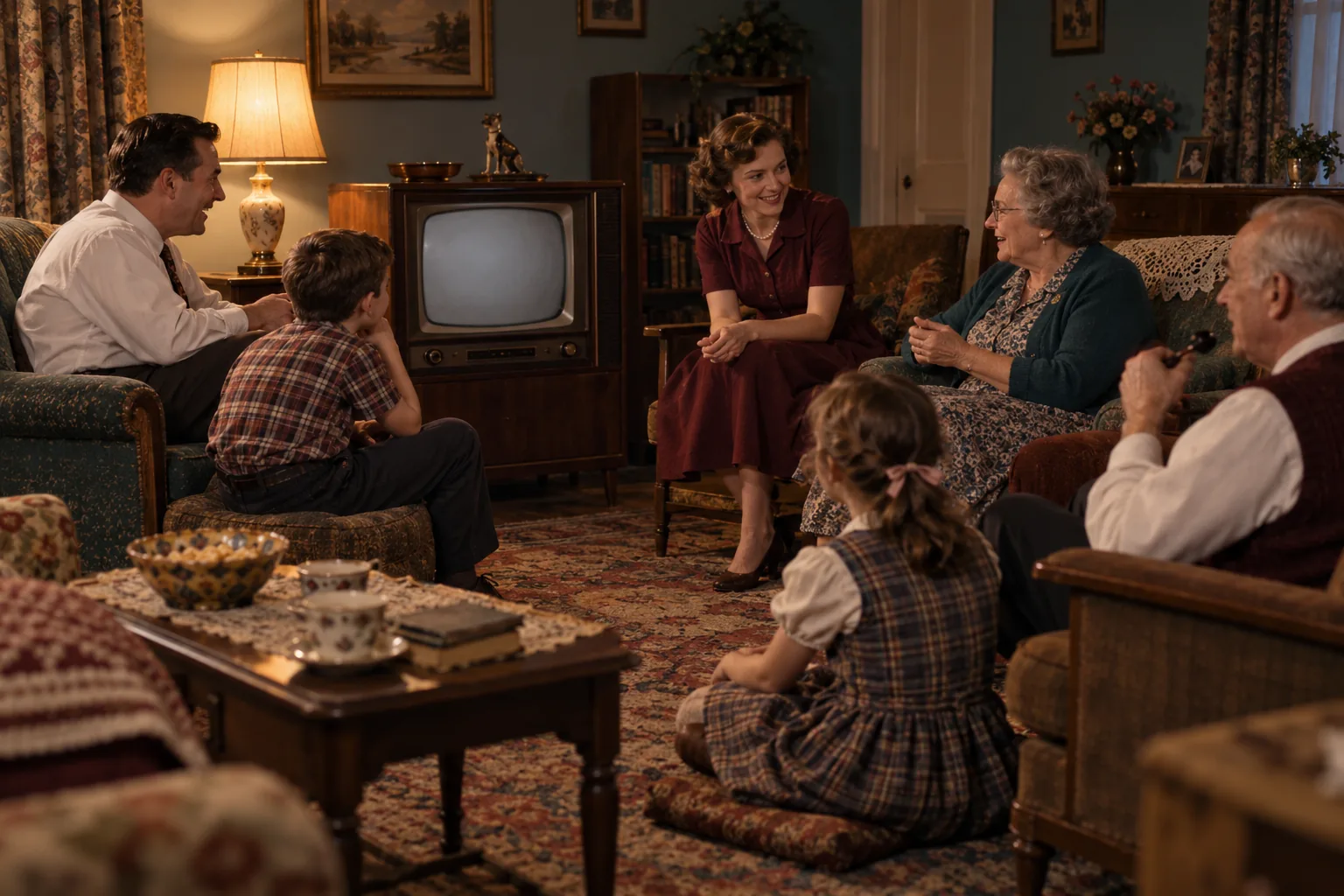
Early television memories are rarely only about the programme. They may include the chair someone sat in, the neighbour who owned the first set, or the family rule about when viewing was allowed.
Begin with the room
Ask where the television stood, how large the screen seemed, and whether curtains were drawn to improve the picture. These details are often easier to recall than an episode title.
Remember the gathering
Some families watched together; some visited neighbours; others preferred radio or cinema. Make space for all of those experiences.
Use a short clip
A comedy scene, opening title, or variety performance can prompt recognition. Avoid asking for the answer immediately. Let voices, music, and visual details do the work.
Ask about change
How did evenings change once television arrived? What happened to radio listening, reading, conversation, or bedtime? The answers can reveal everyday history.
Start before the set was switched on
The story of television often begins with getting access to a set. A household may have saved for one, rented it, visited a relative, or watched through a shop window. Others continued to prefer radio, cinema, reading, clubs, or conversation.
Ask how people learned that a programme was on. Did they consult a newspaper listing, hear about it from friends, or follow a regular weekly routine? The planning around television can reveal as much as the programme itself.
Explore the room and the technology
Invite descriptions of the set’s size, controls, cabinet, screen, aerial, and position in the room. Ask who adjusted the picture, whether reception changed with weather, and what happened when the equipment failed.
A photograph of an early television can support the conversation, but it should not imply that every household owned that model. Encourage comparison: “Was yours anything like this?” A confident “no” is a useful answer.
Remember how people watched together
Early viewing could be a social event. Neighbours might visit the household with a set, children might sit on the floor, and adults could have rules about noise, bedtime, or which programmes were suitable.
Ask who had the best seat, whether refreshments appeared, and what happened during interruptions. These small details help a broad media history become a personal account of home and relationships.
Use clips carefully
Choose a clip under two minutes with clear sound and a simple beginning. Opening titles, a variety performance, a short advert, or a comedy scene may work better than an episode that requires context.
Preview for stereotypes, distressing news, abrupt sound, flashing images, and material that may not suit the group. Introduce what will appear without giving a test question. Afterward, ask what people noticed or how the clip felt.
Look beyond programme titles
- How did television change mealtimes or bedtime?
- Did people discuss programmes at work or school?
- Which family member controlled the set?
- What happened to radio listening after television arrived?
- Were special events watched with a larger group?
- Which programmes were disliked as well as enjoyed?
These prompts welcome people who cannot recall a title. They also include those whose strongest memory is not owning a set.
Compare then and now without deciding which is better
Modern viewers can choose from many channels and watch alone on small screens. Earlier schedules offered fewer choices and more shared timing. Both patterns have advantages and frustrations.
Invite participants to compare remote controls, colour, recording, streaming, and the way families talk while watching. Keep the discussion curious rather than insisting that television once brought everyone together.
Turn the conversation into family history
Draw a simple plan of the room and mark where people sat. Add the set, window, fireplace, and door. A family can annotate the plan with names and routines without needing an exact date.
Record one sentence about what television changed and one thing it did not change. The result captures everyday social history: how technology entered a home and became part of ordinary life.
Use one page to capture the wider story
Divide a sheet into four headings: the room, the people, the programme, and what changed. Add short comments or simple drawings with permission. Someone who cannot name a show may contribute the chair they sat in or the neighbour who visited. The completed page shows that television history is also family and community history. Keep it for a later session, or give a copy to the group according to the setting’s privacy rules.