
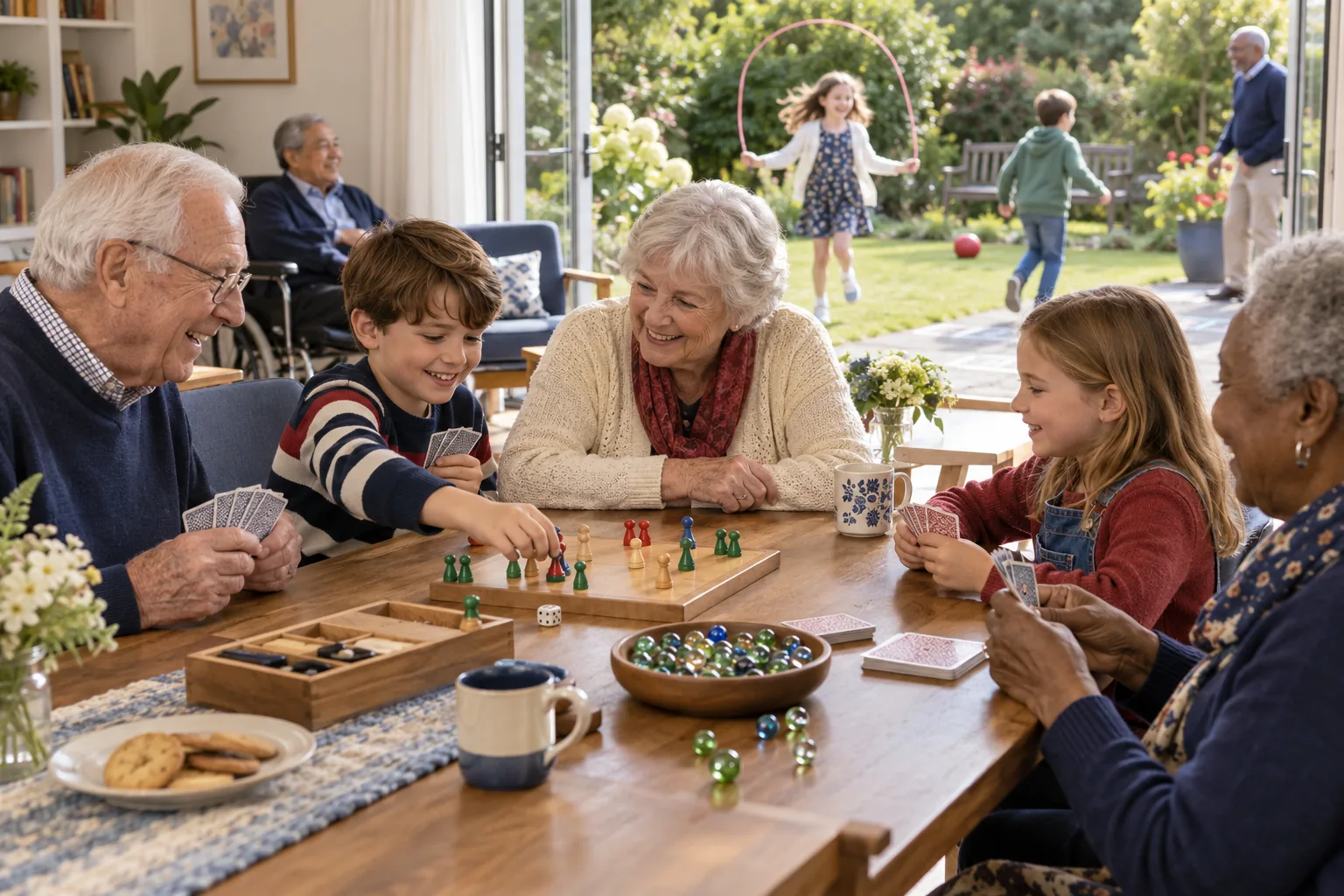
Toys and games can create a lively session because they invite demonstration as well as conversation. Keep the emphasis on play, not ownership; many childhood favourites were homemade or shared.
Make a mixed display
Use pictures or safe objects representing a hoop, skipping rope, marbles, cards, dolls, model vehicles, and board games. Include inexpensive and homemade play.
Ask how it was played
Rules varied by street, school, and family. Invite people to explain their version rather than deciding which rule was correct.
Try a gentle action
Rolling a large soft ball, sorting cards, completing a rhyme, or miming a playground movement allows non-verbal participation.
End with invention
Ask the group to design a simple game using only objects that would have been easy to find. This turns reminiscence into creativity.
Choose a balanced set of prompts
Gather six to ten safe pictures or objects. Include bought, homemade, indoor, outdoor, solitary, and shared play. Cards, marbles, dolls, model vehicles, skipping, chalk games, comics, puzzles, and improvised toys offer different points of entry.
Do not assume that everyone owned toys. Childhood play could depend on siblings, neighbours, found materials, imagination, work responsibilities, and access to safe outdoor space.
Set up for seeing and handling
Place objects on a plain cloth with enough space between them. Use large photographs for items that are fragile, valuable, sharp, very small, or difficult to clean. Remove choking hazards and follow the setting’s infection-control guidance.
Keep the display covered until the session begins if surprise will help attention. Reveal a few items at a time so that the table does not become visually crowded.
Use a simple activity sequence
- Invite everyone to look before asking a question.
- Ask which item they would like to discuss first.
- Explore how, where, and with whom it was used.
- Try one optional action or demonstration.
- Compare rules or versions without selecting a winner.
- Finish with a favourite or invent a new simple game.
The sequence can take 20 minutes or fill a longer session. Follow energy and interest rather than trying to use every item.
Ask about play, not just possessions
Try “What could you play without buying anything?”, “Who taught the rules?”, “Where were children allowed to play?”, or “What happened when it rained?” These questions include routines, places, relationships, and creativity.
Invite disliked games and difficult experiences too. Someone may remember being excluded, losing a treasured object, or having little time for play. Acknowledge the account without forcing a cheerful ending.
Offer gentle ways to join
Roll a large soft ball, sort oversize cards by colour, complete a rhyme, move a counter, or mime an action. Demonstrate slowly and make it clear that watching is also participation.
Avoid timed competition unless the group has chosen it and everyone can take part comfortably. Cooperative tasks usually create more conversation and less pressure.
Welcome different rules
Street games and playground rhymes often varied by place and generation. Ask each person to explain their version. Write the differences on a large sheet or let the group test two versions.
Do not treat uncertainty as a mistake. The discussion about how rules changed may be more interesting than playing the game itself.
Create something for next time
Make a group list titled “Games You Could Play Anywhere” or design a new game using a ball, scarf, cards, or paper. Give it a name chosen by participants and record the rules in simple steps.
Photograph the finished setup only with permission. Store successful prompts together so another facilitator can repeat the activity without depending on private stories.
End on shared enjoyment
Ask which item should return and whether the next session should focus on school, outdoor play, board games, or making things. Put objects away visibly so the ending is clear.
A successful toys-and-games session is not measured by correct rules or scores. It succeeds when people can choose, demonstrate, compare, laugh, remember, or simply enjoy being part of the group.
Make the activity intergenerational
Invite younger relatives or volunteers to bring one current game and learn one older game from the group. Pair people by choice and compare materials, rules, cost, and where each game is played. Keep competition light and optional. The exchange works best when both generations teach and learn. It shows that play changes while familiar elements, such as chance, skill, collecting, imagination, and friendly disagreement, continue across time.