
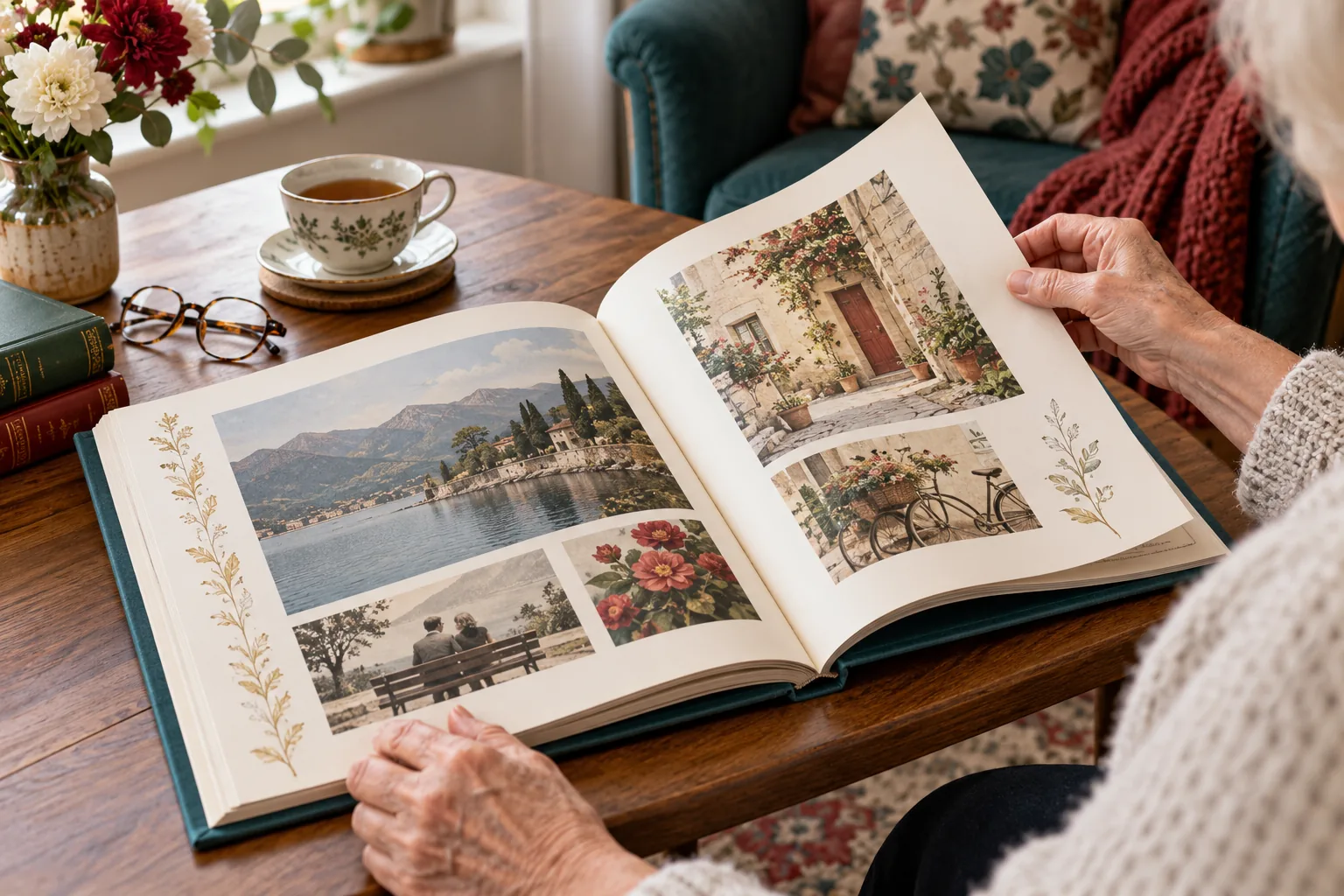
A reminiscence book may be used by an older adult alone, shared during a family visit, or opened by an activity leader in a group. It needs to work in more than one way.
Use this checklist before buying or recommending a title. No book will suit every person, but these qualities make respectful, comfortable use more likely.
Readable pages
- Is the type comfortably large and clearly printed?
- Is there strong contrast between words and background?
- Are paragraphs short, with descriptive headings and generous spacing?
- Can the reader find a new topic without navigating a complicated layout?
Decorative type and busy backgrounds can look nostalgic while making reading harder. Clarity should come first.
Useful images
- Are pictures large enough to share across a table?
- Do captions add context without giving a quiz answer?
- Is there a balance of people, places, and everyday objects?
- Do images represent more than one kind of family or experience?
A familiar kettle or bus ticket may invite more personal detail than a photograph of a famous person.
Inviting prompts
Look for open questions about preference, experience, senses, and change. “What do you notice?” leaves more room than “Can you name this?”
The book should make it easy to skip a prompt. It should not score answers, shame uncertainty, or imply that everyone lived the same life.
Careful historical context
A useful book gives enough background to support conversation and avoids sweeping claims. It distinguishes popular images from everyday reality and makes room for regional, cultural, and economic differences.
Check whether sources are identified or companion links lead to established museums, archives, broadcasters, or public organisations.
Respectful language
The tone should address older adults as adults. Nostalgia can include pleasure, difficulty, disagreement, and change. A good book does not treat the past as universally better or reduce people to a diagnosis.
Medical or therapeutic promises are a warning sign. A reminiscence book can support enjoyable activity and conversation, but it is not a substitute for professional care.
Flexible use
- Can a page work in five minutes or support a longer session?
- Can someone join by looking, listening, choosing, or speaking?
- Does the book lie open comfortably or remain easy to handle?
- Are there optional ideas for music, objects, video, or creative activity?
Flexibility helps families and staff respond to changing energy, attention, communication, and group size.
A clear next step
The best book leaves the reader with something to do: tell a story, choose a favourite, find a photograph, play a song, call a relative, or explore a trusted source.
Memory Lane Chronicles is designed around these principles: large-print topic pages, low-pressure prompts, and optional companion resources for seniors, families, caregivers, carers, and activity leaders.
Test a page in the setting where it will be used
Read a sample in the usual chair and lighting. Place the book on the table, turn several pages, and check whether two people can see the images. A design that looks clear in a shop may feel different in everyday use.
If the book is for a group, hold it at the expected distance or use a document stand. Check whether captions remain readable and whether the binding stays open.
Check what the book leaves out
Look for ordinary work, home life, regional experience, and people beyond the most familiar celebrities. A decade book should not suggest that one fashion, household, or family structure represented everyone.
Good editing uses careful language and welcomes disagreement. A reader should feel able to say, “My experience was different.”
Review companion resources
If the book links to music, video, websites, or downloads, test several resources. They should work, come from trustworthy destinations, and remain optional. The printed book should still be useful when a screen is unavailable.
Check whether links are clearly described and whether access requires accounts, payments, or personal information.
Choose usefulness over decorative nostalgia
A beautiful cover may attract attention, but readable pages, thoughtful prompts, and flexible activities determine whether the book will be reopened. Compare the inside before buying.
The strongest choice respects the reader as an adult and creates several ways to participate. It begins conversation without deciding in advance what someone ought to remember or feel.
Ask the intended reader
When possible, let the person browse two options and choose.